
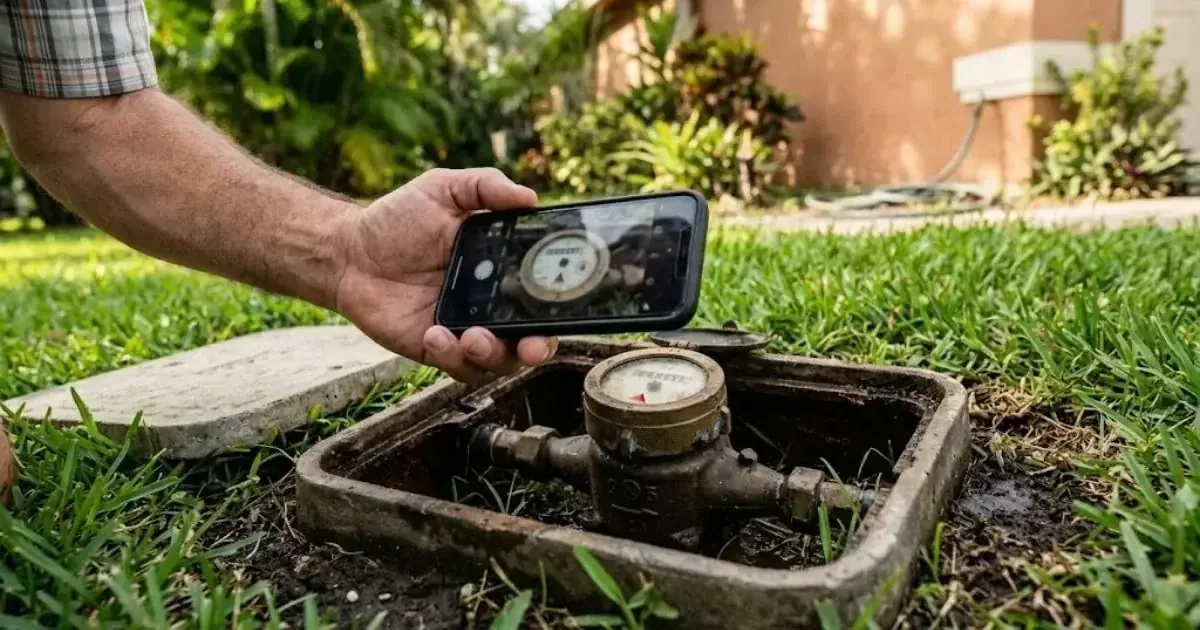
Why the meter test works
The meter counts every gallon that enters your property. If no fixture is open and the meter still counts, water is going somewhere. That is a leak, even if you see no puddle.
The test takes about fifteen minutes the first time, and you can repeat it whenever a bill looks high. UF/IFAS Extension publishes a version of this method for Florida homeowners, and the steps below follow its outline.
The test, step by step
Pick a time when nobody will use water for a short while.
- Turn off all water use. Close faucets, stop the dishwasher and washer, turn off the ice maker and irrigation, and make sure no one flushes.
- Find the meter, usually in an in-ground box near the street or sidewalk. Wear gloves, lift the lid with a screwdriver and remove any cap over the dial.
- Look at the low-flow indicator. It is often a small red triangle or star that turns when water flows.
- If it moves with all water off, water is flowing somewhere after the meter.
- Note the dial reading, wait fifteen minutes or longer, and check again. Some people wait three or four hours with no water use.
- If the reading changed, you have a leak. Close the main valve at the house and check again to see whether the leak is before or after the valve.
Be patient with a toilet leak. A leaky flapper may run only intermittently, so watch the dial for at least five minutes.
Reading what the meter tells you
A few patterns help narrow the source.
| What you see | What it suggests | Next step |
|---|---|---|
| Meter still after closing the main valve | Leak is not on your side, or no leak | Retest, call the utility if unsure |
| Meter stops when the main is closed | Leak is inside the property after the meter | Check toilets, irrigation, then call a plumber |
| Moves slowly, steadily | A small leak such as a toilet or drip | Do the dye test |
| Moves quickly | A larger leak, such as a broken line | Close the main and call |
| Intermittent movement | A toilet filling or an irrigation valve | Watch for longer |
A leak on the buried line between the meter and the house is a job for water service line repair.
Check the usual suspects
Before you call, check these common sources:
- Toilets: put a few drops of food coloring in the tank, wait fifteen minutes without flushing and see whether color reaches the bowl.
- Irrigation: look for a stuck zone valve or a soggy patch in the lawn.
- Hose bibs and outdoor faucets that drip.
- The water heater relief valve and connections.
- Under-sink supply lines and shutoff valves.
- A softener or filter that is running on its own.
If all of those are clear and the meter still moves, the leak is hidden, and the next step is leak detection with acoustic and thermal tools.
What to do with the result
If the meter stays still, you have no active leak, and a high bill has another explanation, such as higher use or irrigation. Compare your usage history and talk to the utility.
If it moves, shut off the main when you are away and arrange a visit. Small leaks waste more than most people expect over a month. A slab leak can look exactly like this, and our slab leak page explains the repair route.
Repeat the test to be sure
One reading is useful, but two are better. Run the meter test at a quiet time, write down what the leak indicator or the dial does, and then repeat it on another day. A leak that shows up both times is real, and a movement that shows up once may have come from an appliance that cycled on.
If you can, test again after shutting off the supply to individual fixtures. Closing the small valve under a toilet or at the water heater and watching whether the dial slows helps narrow the search before anyone opens a wall.
Keep your notes with the dates and times. They give a plumber a head start, and they support a conversation with the utility if your bill is unusually high.
Once the meter test points to a leak, call (321) 463-9969 and share the readings you wrote down.
Saint Cloud local note: the utility and who owns which pipe
Toho Water Authority's service area page lists Saint Cloud, Kissimmee and Poinciana among the communities it serves. Your meter belongs to the utility, and typically the pipe on the house side of it is the homeowner's, so a leak found after the meter is yours to fix. Confirm where responsibility ends with Toho for your address.
On the county permit page, repairing a leak needs no permit, so a plumber can usually fix a found leak without one. Re-piping does need a permit, and the building department for your address can say whether a larger job qualifies.
Where this comes from, according to the pages themselves: UF/IFAS Extension guidance, the utility's service area page and the county permit information page. Readers in Kissimmee and Harmony can follow the same test.
Quick answers for Saint Cloud homeowners
Where is my water meter in Saint Cloud?
Usually in an in-ground box near the street or sidewalk in the front yard. If the lid is stuck, call and we can help.
What does the red triangle on the meter mean?
It is a low-flow indicator. When it turns, water is flowing through the meter, even slowly.
Is it safe to open the meter box?
Wear gloves, watch for insects and use a screwdriver to lift the lid. Do not tamper with the meter itself.
My meter moves but I find no leak. What now?
The leak may be underground or inside a wall. A plumber with acoustic tools can find it.
Will fixing a leak need a permit in Osceola County?
The county's permit page lists repairing leaks as not requiring a permit.