
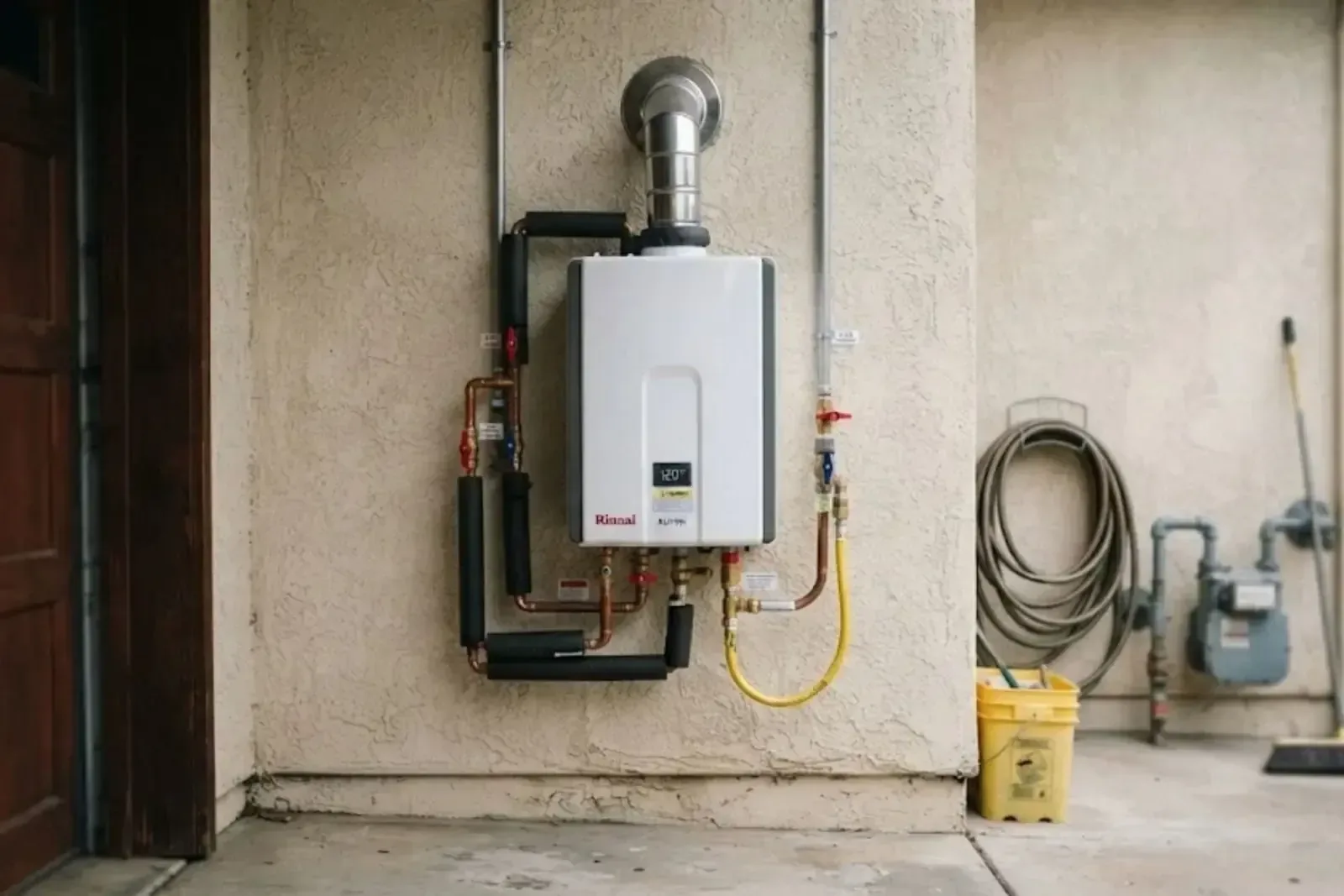
How a tankless heater works
A tankless water heater, also called an on-demand heater, turns on when you open a hot tap. Water flows through a heat exchanger that a gas burner or electric elements heat on the spot, and then it continues to the fixture. There is no storage tank to keep warm and no tank to rust through.
The limit is flow rate. Each unit can raise a certain number of gallons per minute by a certain number of degrees, so running two showers and a dishwasher at once may exceed it. A plumber sizes the unit to the household's peak demand.
Gas and electric tankless compared
The right choice usually comes down to what your home can support.
| Gas tankless | Electric tankless | |
|---|---|---|
| Output | High flow, suits larger households | Often best for smaller homes or point-of-use |
| Needs | Larger gas line, venting and combustion air | Several large circuits and panel capacity |
| Install work | Venting and gas piping are the big tasks | Electrical upgrades are the big tasks |
| Maintenance | Annual descaling and vent checks | Annual descaling and element checks |
Florida's mild groundwater temperatures mean the unit has a smaller temperature rise to deliver than a heater in a cold state, which helps flow rates. The panel and gas line are still the deciding factors.
Signs a tankless heater needs service
These are the usual calls we get about tankless units:
- An error code on the display, often tied to ignition, flame, flow or venting.
- Hot water that surges between hot and cold.
- A longer wait for hot water at the tap.
- Reduced flow at the faucets, which can mean scale in the heat exchanger or a clogged inlet filter.
- A rumbling or kettle-like noise as scale builds up.
- Water leaks around the unit's connections or the isolation valves.
Write down the code before you reset the unit. The code tells the plumber which parts to check.
Descaling and flushing
Mineral scale is the main enemy of a tankless heat exchanger. As water heats, dissolved minerals come out as scale on the inside surfaces, which narrows the passages and makes the unit work harder. Annual flushing with a descaling solution removes it, and many manufacturers require it for warranty coverage.
A flush uses isolation valves, a small pump and a bucket of solution that circulates through the unit for a set time. It is a good routine whether or not you have a hardness problem. Your Saint Cloud water comes through Toho Water Authority, and its 2025 report does not list a hardness figure, so test your tap or ask the utility.
Check the inlet filter screen on each flush. A clogged screen cuts flow and mimics a failing heat exchanger.
Installing a tankless unit in an existing home
Switching from a tank to a tankless unit is a bigger job than a like-for-like swap. A gas unit needs a larger gas line and a sealed vent, which means new pipe and sometimes new penetrations through the wall or roof. An electric unit needs a heavy circuit or several, and some older panels cannot carry the load.
The plumber should check the gas meter capacity, the panel, the vent route and the clearances before quoting. If the home cannot support the unit, the honest answer is to say so and suggest a hybrid tank instead, which our installation page covers.
Permits apply. Osceola County lists water heaters as permit-required work, and a tankless conversion adds gas or electrical work that may bring its own inspection.
Standards for tankless units
Tankless heaters carry gas or electric loads, so installation follows NFPA 54 for gas, the NEC for power and the manufacturer's guidelines for venting and descaling. The Florida Building Code, Plumbing covers the water side, and the utility's report does not list hardness, so test your tap.
What decides the price of a tankless job
We price tankless work after we see the home:
- Unit size. Flow rate and temperature rise decide the model.
- Fuel. Gas needs venting and piping, and electric needs a panel and circuits.
- Existing setup. A like-for-like swap is simpler than a tank-to-tankless conversion.
- Water quality. A softener or a scale filter may be advisable, depending on test results.
- Permit. Where a permit applies, we include it in the quote.
Tankless units cost more up front than a basic tank, and savings depend on usage. To price one for your home, call (321) 463-9969.
Questions we hear from Saint Cloud callers
How long does a tankless water heater last?
With regular flushing, many tankless units last 20 years or more, longer than a typical tank. Scale and neglected maintenance shorten that, which is why annual descaling matters.
Why is my tankless water heater showing an error code?
Codes point to a specific system, such as ignition, flame sensing, venting or flow. Check the manual for the code, write it down and call a plumber, who can test the part behind it.
Can I install a tankless heater on my own?
Gas and electrical connections plus venting require licensed work in Florida, and water heater work needs a permit in Osceola County. Hire a licensed plumber and verify the license at myfloridalicense.com.
Do tankless heaters run out of hot water?
They do not run out, but they can fall short on flow. If too many fixtures run at once the water cools. A plumber sizes the unit to peak demand to prevent that.
Do you service tankless heaters at night?
A leaking or failed tankless unit that is flooding the space is an emergency, and the 24/7 line books the first open appointment. Planned flushes are scheduled at your convenience.