
What water heater replacement involves
Water heater replacement is the removal of a failed or end-of-life heater and the installation of a new one that meets current manufacturer instructions and local code. It includes disconnecting the old tank, setting the new one, connecting water, power or gas and venting, and testing the whole system before you use it.
It is more than swapping a tank. New flexible connectors, a relief valve discharge line, an expansion tank where the system needs one, a drain pan and a permit where required all belong in a proper replacement.
When a failed water heater is an emergency
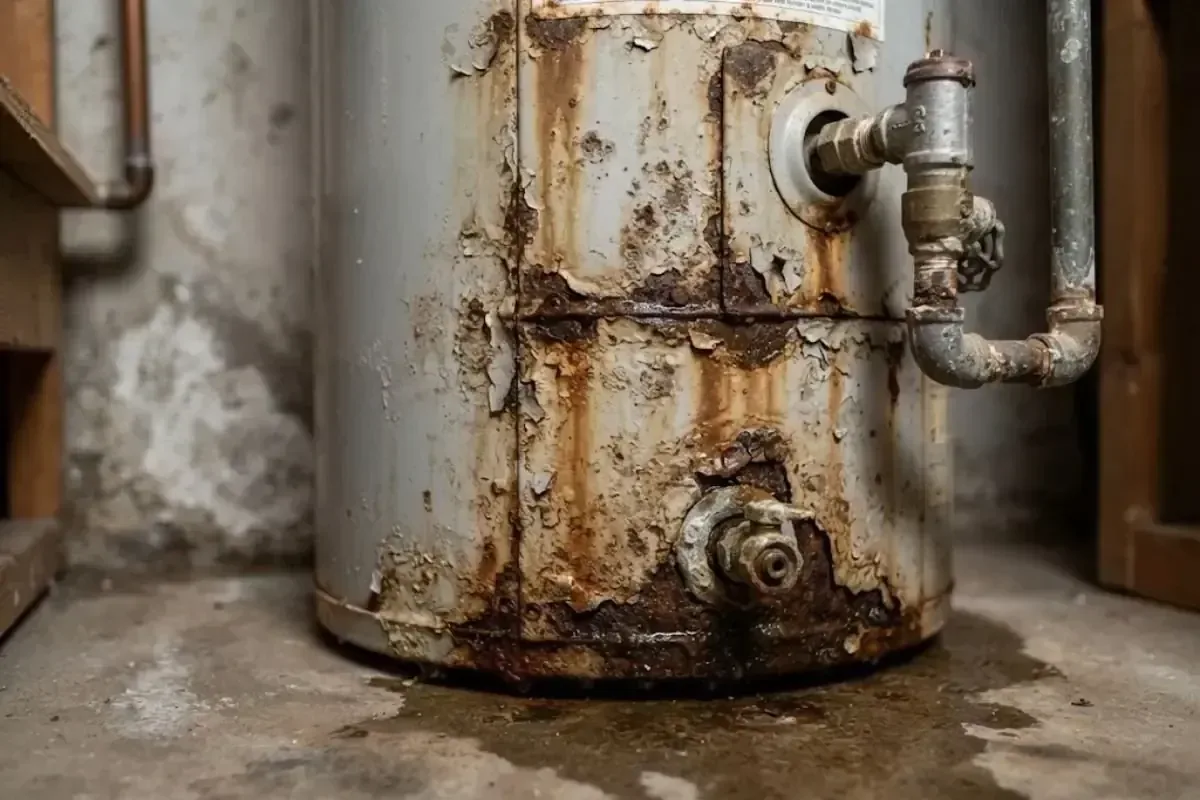
A leak from the tank body is the clearest case. Rust-colored water around the base, a steady drip from the bottom or a puddle that returns after you wipe it up means the steel has failed. We answer 24/7 and book the first open slot.
Close the cold water shutoff on top of the unit, turn off the breaker or set the gas control to off, and drain a few gallons through the lower valve only if the plumber asks. Lift or move anything on the floor.
A same-day appointment is possible when available, and a plumber can often replace a standard tank in one visit if the unit is in stock. Special sizes or locations may take longer, and we tell you before work starts.
Signs the heater should be replaced and not repaired
These signs point toward replacement:
- Water leaks from the tank body or from underneath the insulation.
- The unit is more than about twelve years old and starts needing repairs.
- Hot water runs out faster than it used to, or the water is rusty.
- The tank rumbles and pops loudly from sediment you cannot flush out.
- Repairs have cost more than half the price of a new unit within a year.
Look at the data plate on the tank. The serial number usually encodes the manufacture date, and the plumber can read it if you cannot.
Choosing the replacement type
Most Saint Cloud homes choose among four options. The right one depends on fuel, space and how much hot water the household uses.
| Type | Good fit | Watch for |
|---|---|---|
| Standard electric tank | Homes with electric service only and a simple swap | Higher energy use than a hybrid unit |
| Gas tank | Homes that already have gas or propane and a proper vent | Venting and gas supply must match the new unit |
| Hybrid heat pump tank | Garages and utility rooms with good airflow | Needs clear space, a condensate drain and a warm location |
| Tankless | Households that want endless hot water and have the circuits or gas line for it | Higher up-front cost and scale management |
The installation page goes into each type, and the tankless page covers the on-demand option in depth.
Permits and code on a Saint Cloud replacement
Osceola County's permit page lists water heaters among the plumbing work that requires a permit. Inside city limits the building department that covers your address sets the process, so ask it what applies to your house.
A permit exists so someone checks the venting, the relief valve discharge and the electrical or gas connection. It matters for your insurer and for resale, because an unpermitted install can raise questions at a home sale.
Florida requires plumbing work to be done by a licensed plumber. You can verify any plumber's license on the state's licensing lookup at myfloridalicense.com.
What decides the price of a replacement
A replacement quote has more moving parts than a repair, and we give a clear price before work starts:
- Unit type and size. A 40 gallon electric tank is a different price from a hybrid or a tankless unit.
- Location. A garage swap is simpler than an attic or a tight closet.
- Code upgrades. Expansion tanks, drain pans, relief valve lines and venting corrections add parts.
- Permit. Where a permit applies, its cost and the inspection time belong in the quote.
- Haul-away. Removing the old tank is part of the job, and we confirm it in the quote.
Insurance may cover damage from a sudden tank failure but usually not the heater itself. To price a replacement, call (321) 463-9969 and tell us the current type and location.
Codes for a replacement tank
A replacement heater must meet the Florida Building Code, Plumbing, including a relief valve and a safe discharge line. Gas units follow NFPA 54 and electric units follow the NEC, and Osceola County's permit page lists water heaters as permit-required.
After the new heater is in
Ask the plumber to show you the shutoff valve, the relief valve and the drain, and write down the install date. Flushing the tank once a year slows sediment, and checking the anode rod every few years extends tank life.
We replace heaters across 34769, 34771, 34772 and 34773 and in Kissimmee.
Questions we hear from Saint Cloud callers
Do you handle water heater replacement emergencies at night or on weekends in Saint Cloud?
Yes. The line is answered 24 hours a day. A dispatcher books the first open appointment for a leaking tank, and we tell you whether a replacement can be done the same day.
How long does a water heater replacement take?
A standard tank swap often takes a few hours. Tankless conversions, new venting or new electrical circuits take longer. The plumber gives a plan once the location and fuel are confirmed.
Does a water heater replacement need a permit in Osceola County?
Osceola County's permit page lists water heaters as work that needs a permit. Inside city limits, the city building department sets the process, so ask the office that covers your address.
Should I replace a 10-year-old heater before it fails?
A planned replacement avoids a flood and lets you choose the unit. A heater past about ten years with rust, noise or leaks is a candidate, and the plumber can inspect it first.
What size water heater do I need?
Size depends on household size and peak use. A common tank size is 40 or 50 gallons for many homes, and a plumber matches it to the number of bathrooms and fixtures.