
Start with the question: is it really the slab?
Many homeowners hear the words slab leak and assume the worst. A rising water bill, a damp patch or a hissing sound can have other sources, such as a running toilet, an irrigation valve or a pipe in the attic.
Rule out the easy causes first. Check toilets with food coloring, look at hose bibs and irrigation zones, and watch your water meter with every fixture off. If the meter still moves and nothing visible is leaking, the next stop is detection, not demolition.
If all of those checks come back clean, a slab leak moves up the list. The sections below walk you through what comes next.
Clues that point to the slab and clues that do not
Use the clues together, since none is conclusive alone.
| Clue | Points to the slab | Points elsewhere |
|---|---|---|
| Warm spot on the floor | Hot line leaking below | A sun-heated window or a floor vent |
| Hissing with all fixtures off | Pressurized leak nearby | A toilet valve or an appliance |
| Wet carpet or baseboard | Water rising through the floor | A wall leak or a roof leak |
| Bill increase | A continuous loss | Irrigation, a pool fill or higher use |
| Cracks in tile or walls | Soil washed from under the slab | Normal settlement |
A plumber with acoustic and thermal tools can separate these quickly. Our page on leak detection describes the process.
What a good detection visit looks like
A competent plumber starts by isolating the system. A pressure test on the cold and hot lines tells you which side is losing water. Then acoustic equipment listens along the floor for the leak's sound, and a thermal camera can show where hot water warms the slab.
The plumber marks the leak location on the floor, usually within a foot or two, and shows you the evidence. If they cannot find it, they should say so, and not start cutting.
Ask for a written description of the finding. It helps with insurance and with comparing repair quotes.
Repair choices explained
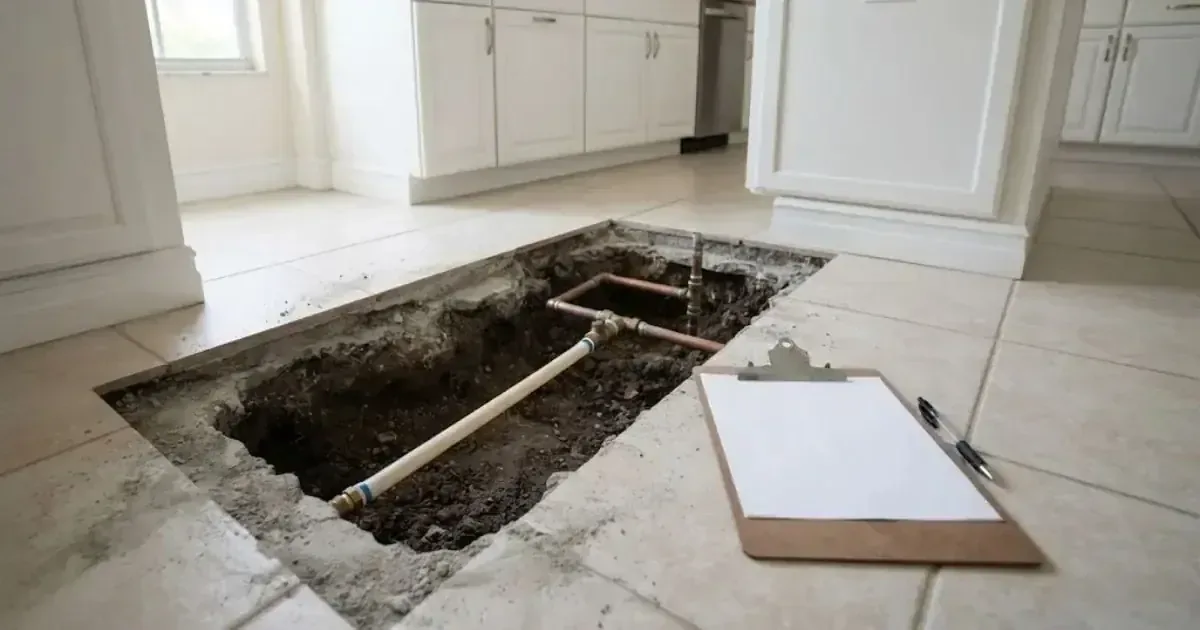
A spot repair opens the slab over the leak, replaces a short length of pipe and patches the concrete. It is the least costly option up front. A reroute abandons the slab line and runs a new one overhead through the attic or walls, which avoids the slab for good. Lining coats the inside of the pipe with a sealing material, where the pipe suits it.
A repipe replaces the whole supply system. It makes sense when the pipe is failing in many places or when it is a material known for problems, such as polybutylene.
The decision turns on how many leaks exist, how old the pipe is and whether another leak is likely soon. A plumber who finds one pinhole in a thirty-year-old copper line should tell you what is likely next. Our repiping page covers that bigger step.
Questions to ask before approving a repair
These keep the conversation honest:
- How did you find the leak, and can you show me the evidence?
- How many leaks are there, and how likely is another?
- What repair options exist and what are the trade-offs?
- What happens to the flooring, and who restores it?
- Is a permit needed, and who pulls it?
- What does the warranty cover, and for how long?
A plumber who answers clearly is easier to trust than one who pushes a single option.
Insurance and records
Many homeowner policies cover sudden accidental water damage but often exclude gradual seepage. Some pay for the cost of accessing the pipe, and others do not. Read your policy and call your agent early.
Take photos of the damage, keep the plumber's report and invoice and note dates. If the leak caused damage to floors or walls, document them before any cleanup. A claim is easier to support when you have the evidence in hand.
To locate a suspected slab leak without opening the floor, call (321) 463-9969 and share what your water meter does.
Saint Cloud local note: permits, the water supply and home age
Under the county permit page, repairing a leak needs no permit and re-piping does. A spot repair is a repair, but a reroute or a repipe may count as re-piping, so ask the building department for your address.
Toho Water Authority supplies water to Saint Cloud, Kissimmee and Poinciana according to its service area page. The 2025 report for the Saint Cloud system says it applies corrosion control, and it lists chlorine at an average of 1.57 parts per million. Those facts do not replace a camera or a pressure test, though, and the plumber decides what is happening in your pipes.
Homes in Harmony date from the early 2000s onward, as the community's first residents arrived around 2003, so a slab leak there is less likely to involve very old pipe. Source types for this note: the Osceola County permit information page and the Toho Water Authority service area page and annual report. We serve Harmony and Kissimmee.
Quick answers for Saint Cloud homeowners
Does a slab leak repair need a permit in Osceola County?
The county lists repairing leaks as not requiring a permit and re-piping as requiring one. A reroute may count as re-piping, so ask the building department that covers your address.
Can I fix a slab leak myself?
Locating the leak requires specialized tools, and the repair involves concrete and pressurized pipe. Plumbing is a regulated trade in Florida, so most homeowners hire a licensed plumber.
How quickly should I act on a suspected slab leak?
Promptly. The leak wastes water by the hour, and soil can wash from under the slab.
Will a slab leak go away if I ignore it?
No. Pipe leaks tend to grow, and the water damage adds to the cost.
Is leak detection worth paying for before a repair?
Yes. A precise location means a smaller opening and a more accurate quote.