
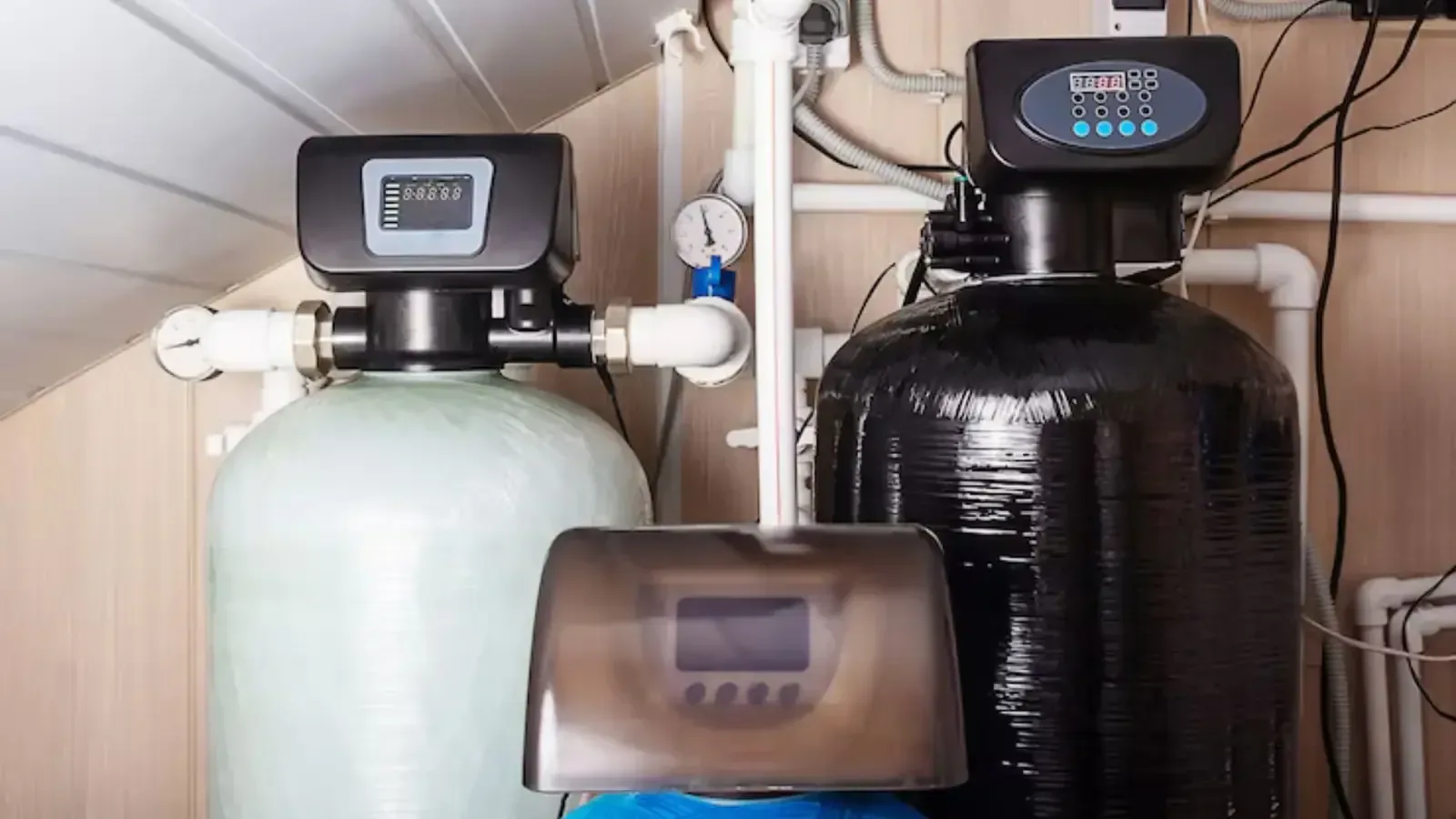
Softener, filter or both?
A water softener swaps hardness minerals, mostly calcium and magnesium, for sodium or potassium through ion exchange, which prevents scale. A filter removes particles, chlorine taste or odor, and a reverse osmosis system filters drinking water to a fine level at one tap.
They solve different problems. Scale on fixtures and in water heaters points to hardness. A chlorine smell or sulfur odor points to a carbon filter or aeration. Sediment points to a particle filter. Start with a test, not with equipment.
What the utility report does and does not say
Saint Cloud's water comes from the Floridan aquifer through Toho Water Authority.
The report says the aquifer water is treated with MIEX ion exchange, aeration to remove hydrogen sulfide and chlorine disinfection, and it applies corrosion control. It reports sodium at up to 46.3 parts per million and chlorine at an average of 1.57 parts per million. It does not list a hardness figure.
Because the report gives no hardness number, we do not guess one. Test your tap with a home test kit or a certified lab, or ask Toho for its water quality information, and then decide whether a softener is worth it.
Matching a complaint to a solution
Use this to point you toward the right kind of treatment after testing.
| What you notice | Likely cause | Common solution |
|---|---|---|
| White crusty scale on faucets, spotty glass | Hard water minerals | Water softener, or a scale-control device |
| Chlorine taste or smell | Disinfectant in treated water | Carbon filter on the whole house or at the tap |
| Rotten egg smell at every tap | Hydrogen sulfide in the supply | Whole-house treatment, test the source |
| Rotten egg smell in hot water only | Water heater anode rod reaction | Service the heater, see water heater repair |
| Sand or grit in aerators | Sediment | Sediment filter |
| Drinking water taste | Dissolved solids and taste compounds | Reverse osmosis at the kitchen tap |
Do not buy equipment before testing. A treatment that suits one house can be useless in another.
If you use a softener, think about sodium
A salt-based softener adds sodium in proportion to the hardness it removes. Toho's report lists sodium up to 46.3 parts per million in the supply already. People on a low-sodium diet should ask their doctor, and some households keep an unsoftened cold line at the kitchen sink or use a potassium-based regenerant.
Softeners also need a drain connection for their regeneration cycle and an outlet for the control head. The installer should place the unit in a garage or utility room with access for salt refills.
If your home is on a private well
Some properties outside the city and in rural parts of Osceola County use private wells, which are not covered by a utility's annual report. If you have a well, test it for bacteria, nitrates, iron, hardness and pH before choosing a system. A filter that works for city water may not be enough for a well.
Ask a certified lab for the test, and bring the results to the installer so the system is sized to the actual water.
How an installation runs
A whole-house installation follows these steps.
- Test the water and confirm the target, such as hardness, chlorine or sediment.
- Choose the equipment and a location near the main line, with power and a drain.
- Shut off the water, cut into the main and install the bypass valve and the unit.
- Connect the drain line and power, and program the control head.
- Flush, test for leaks and show you how to add salt or change a filter.
Plan the filter or salt schedule. A softener without salt does not soften, and a filter left in place too long stops working.
What decides the price of water treatment
We price after you know what you are treating:
- Test results. Hardness, chlorine and sediment levels set the equipment.
- Whole house or point of use. A whole-house system costs more than an under-sink filter.
- Capacity. Larger households need larger tanks.
- Installation conditions. A bypass, a drain and a power source are required.
- Ongoing costs. Salt, filters and membranes are part of the real cost.
Insurance does not cover treatment equipment. For a price, call (321) 463-9969 with your test results.
Water conditioner service and repair
A softener or conditioner that has stopped working is usually a salt, valve or resin problem. A salt bridge, a clogged injector, a stuck control valve or a tank that has run out of salt will each bring hard water back. The unit often tells you which one with an error code or a sound.
Before paying for a replacement, ask whether the unit can be serviced. Older conditioners are often worth rebuilding if the tank is sound, and the plumber can tell you the age of the resin and the condition of the valve.
Certification to look for
Softeners are tested to the NSF/ANSI 44 standard and many filters to NSF/ANSI 42 and 53, so check for those marks. The Florida Building Code, Plumbing covers the connection and drain, and the Saint Cloud utility report does not list a hardness figure.
Related service
A scale-free system helps your heater last longer, so see water heater installation. We serve Kissimmee and Saint Cloud ZIP codes 34769, 34771, 34772 and 34773.
Questions we hear from Saint Cloud callers
How do I know if my water is hard?
White scale on fixtures, spots on glassware and soap that does not lather are signs. Confirm it with a test kit or a lab, since the utility's report does not list a hardness figure.
Does a water softener make water salty?
A softener adds a small amount of sodium. Many people do not taste it. If you are on a low-sodium diet, ask your doctor.
Is a reverse osmosis system worth it?
It improves drinking water taste at one tap, and some people prefer it. It wastes some water and needs new filters, so decide after tasting your tap water.
Do I need a softener if I have a tankless heater?
Scale shortens the life of a tankless heat exchanger. Test your tap first, since a softener is one option and annual descaling is another.
Do you handle water treatment emergencies?
Treatment is planned work. A leaking tank or a failed valve is urgent, and the 24/7 line answers day and night.