
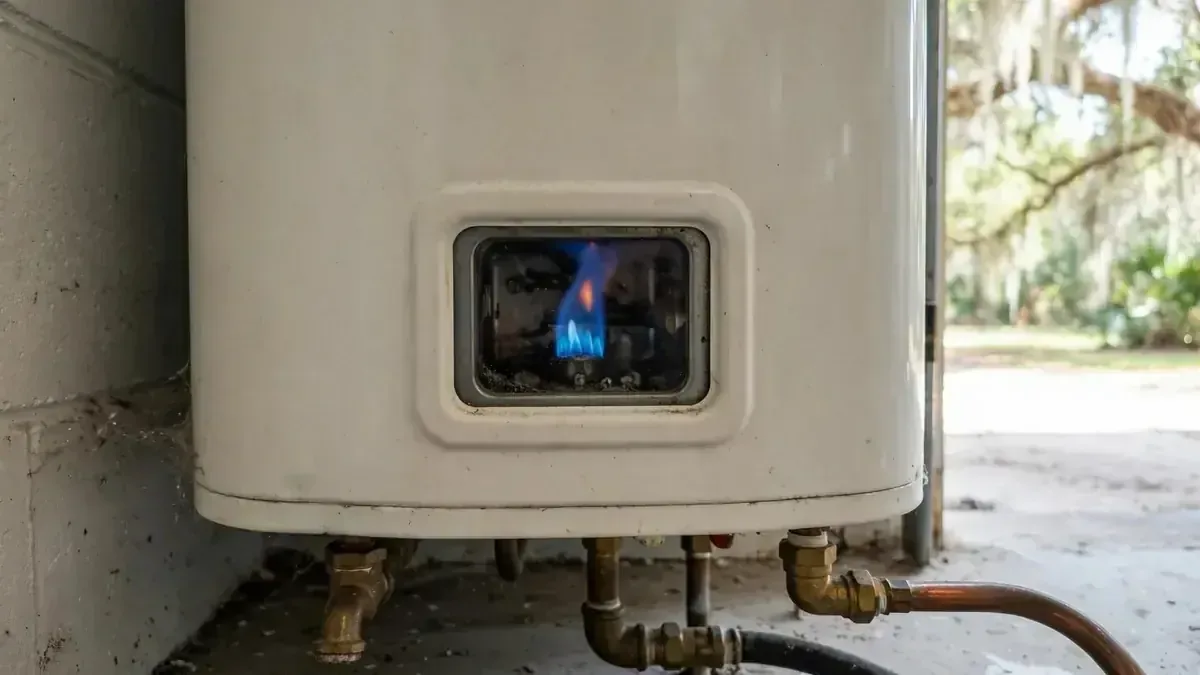
Safety first
If you smell gas, leave the house at once. Do not use switches or phones inside. From outside, call the gas utility or 911. A plumber comes after the area is safe.
If there is no smell, you can check the basics. Gas water heaters have warnings on the front of the tank. Read them before you touch the controls, and follow the relighting steps on the label.
Electric water heaters have no pilot light, so if you have an electric unit, this article does not apply. Check your breaker instead.
Why a pilot light goes out
The usual causes, from simplest to most involved.
| Cause | How it shows up | Fix |
|---|---|---|
| Dirty pilot assembly | Weak or yellow flame, goes out soon | Clean the pilot and the orifice |
| Failed thermocouple | Lights, then goes out when the button is released | Replace the thermocouple |
| Draft or blocked flue | Goes out in wind or when the vent is blocked | Clear the vent, check the draft |
| Gas supply problem | Weak flame or no flame | Check the valve, call the gas utility |
| Faulty gas control valve | Pilot lights but main burner will not | Replace the control valve |
| Low gas pressure or a regulator fault | Pilot goes out on high demand | Test pressure, call a pro |
A thermocouple is a small sensor that sits in the pilot flame. It tells the gas valve that the flame is present. If it fails, the valve closes and the pilot goes out.
Relighting, in general terms
Follow the instructions on your heater's label, since models differ. The usual order is as follows.
- Turn the gas control knob to off and wait five minutes for any gas to clear.
- Turn the knob to pilot and hold the pilot button down.
- Light the pilot with the built-in igniter or a long lighter, as the label shows.
- Hold the button for about a minute after the pilot lights, then release it slowly.
- If the pilot stays lit, turn the knob to on and set the temperature.
- If it goes out again, stop and call a plumber.
Do not keep trying if the pilot will not stay lit. Repeated attempts can release gas.
When the thermocouple is the problem
A thermocouple wears out from years of heat. A replacement is an inexpensive part, and for a plumber it is a short job. The plumber also checks the pilot assembly, the burner and the flue while the unit is open.
If the unit is old and showing rust, sediment or other problems, a repair may not be the best use of money. Our water heater replacement page explains when replacing is wiser, and the installation page covers choices such as electric or hybrid models.
Electric or gas in a Florida home
Many Florida homes use electric water heaters, and a gas heater needs a gas or propane supply and a proper vent. If your heater is gas and you are replacing it, you can keep gas or switch fuel, depending on what your home supports.
Heat pump hybrid units are popular in warm climates because they work by moving heat from the surrounding air. Ask a plumber which option suits your garage or closet.
Keeping a record for the plumber
A pilot light problem is easier to solve when the plumber knows its history. Note how often the flame goes out, whether it happens after a storm or a gust of wind and whether the burner lights normally when the pilot is on. A flame that dies within seconds suggests a different cause from one that lasts for a day.
Write down the model and the age of the heater from the data plate, and note what color the pilot flame is when it burns. A steady blue flame is a good sign, while a yellow or flickering one calls for professional attention.
Pass those notes along when you call. They shorten the diagnosis and help the plumber decide whether to bring a thermocouple, a gas valve or a replacement unit.
When the flame will not hold, call (321) 463-9969 and tell the dispatcher how long it stays lit.
Saint Cloud local note: gas, permits and who to call
Gas availability depends on your address. Ask the gas utility serving your street or your propane supplier whether service is available and who is responsible for the line up to the meter. For problems with gas, call the utility first.
Water heaters are permit-required work on the county permit page, so replacing a gas unit needs one. Swapping a thermocouple is a repair inside the unit that the page does not name, so ask the building department for your address if you are unsure.
Where this comes from, according to the pages themselves: the county permit information page and general utility guidance. Pilot light calls come in from Kissimmee and Harmony as well.
Quick answers for Saint Cloud homeowners
Is it dangerous if my pilot light keeps going out?
It can be if gas is escaping. If you smell gas, leave and call the gas utility or 911. Otherwise, stop relighting after one or two tries and call a plumber.
How do I know if my heater is gas or electric?
A gas heater has a gas line, a control knob with a pilot setting and a flue on top. An electric one has a wiring cable and no flame.
Can I replace a thermocouple myself?
It is a common repair, though gas work carries risk. Plumbing is a regulated trade in Florida, so many homeowners hire a plumber.
Why does my pilot go out when it is windy?
A draft in the flue or a gap near the heater can blow it out. A plumber can check the vent and the combustion air.
Does a water heater repair need a permit in Osceola County?
The county lists water heaters among permit-required work. A part replacement is not named, so ask the building department that covers your address.