
First, stop the water
A leaking tankless unit can flood a wall and a floor, and gas models raise a safety issue too. Close the cold water supply valve to the unit, switch off the electrical breaker or turn off the gas valve, and put a bucket or towels under the drip.
If you smell gas, leave the house and call the gas utility or 911 from outside before you call a plumber. Do not touch switches.
Once the unit is off, look at where the water is coming from and whether it is clear, rusty or oily. That detail helps the plumber.
Where the water comes from and what it means
Water at the bottom does not always mean a failed unit.
| Source | Common cause | Usual fix |
|---|---|---|
| Isolation valves | Loose or worn valve seals | Tighten, replace the seal or valve |
| Water connections | Loose union, cracked fitting | Tighten or replace the fitting |
| Condensate line | Clogged or disconnected drain on a condensing gas unit | Clear the line, check the neutralizer |
| Pressure relief valve | High pressure or a failing valve | Check pressure, replace the valve |
| Heat exchanger | Scale, corrosion or a freeze or age crack | Often means replacing the unit or the exchanger |
A condensing gas tankless unit produces acidic condensate that drains through a small plastic line. If that line clogs, water backs up and drips. It is a common and simple cause.
What to check before you call
These checks take a few minutes and give the plumber a head start.
- Dry the area and the pipes under the unit with a towel.
- Run hot water for a minute and watch where drops first appear.
- Check the isolation valves and the connections for moisture.
- Look at the condensate line, if the unit has one, for kinks or a clog.
- Write down the model, the error code on the display and the age of the unit.
Do not run the unit repeatedly while it leaks. A leak at the heat exchanger can short electronics or damage the burner.
Scale and the heat exchanger
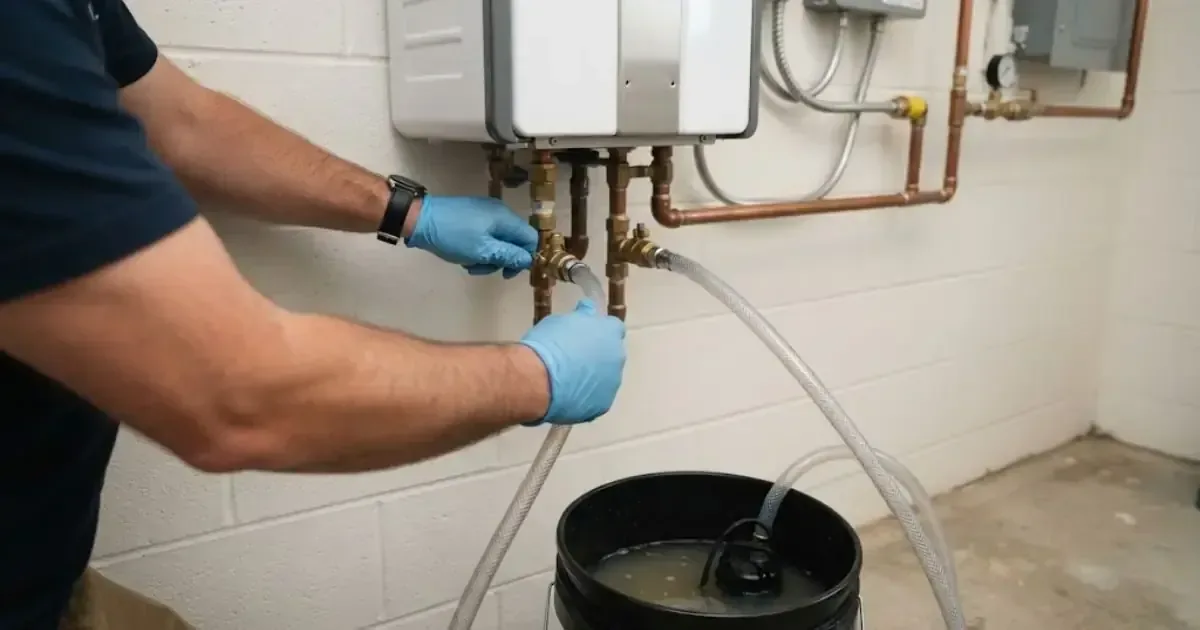
Tankless heat exchangers are narrow, so mineral scale builds up and strains the metal. Over time, repeated heating and scale can cause a pinhole or crack, which then leaks. Annual descaling with a flush kit reduces that risk, and many manufacturers require it for warranty coverage.
A leaking heat exchanger is rarely a field repair. Depending on the unit's age and warranty, the choice is to replace the exchanger or replace the unit. A plumber can tell you which makes sense. Our tankless page covers flushing and when each option applies.
Repair or replace
A loose valve or a clogged condensate line is a quick repair. A cracked heat exchanger on a unit that is out of warranty may cost nearly as much as a new heater, so compare quotes.
If you decide to replace, a hybrid tank is an alternative when your home cannot support another tankless install. See water heater installation for the options, and if the unit has failed in the middle of the night, our water heater replacement page covers the emergency route.
Record what you see before the visit
A leak that comes and goes is hard to diagnose after the fact. Before the plumber arrives, note when the dripping happens. Does it start when a hot tap opens, after the unit shuts off or only in certain weather? A drip that follows a hot water draw points to a fitting or the heat exchanger, while one that follows a shutdown can point to condensate.
Take a photo of the unit from the front, a photo of the pipes underneath and a short video of the drip if it is steady. Wipe the area dry and place a paper towel under the leak. The pattern of wet spots on the paper shows which connection is the source.
Share the model and age of the unit when you call. Some leaks come from known weak points in a given design, and the dispatcher can pass those details to the plumber so the right parts are on the truck.
If your unit keeps dripping, call (321) 463-9969 and have the model number and your notes ready.
Saint Cloud local note: scale, permits and utilities
Toho Water Authority's 2025 report for the Saint Cloud system does not list a water hardness figure. Because scale threatens a tankless heat exchanger, test your tap with a home kit or a lab, or ask Toho for its water quality information, and descale on a regular schedule.
Water heaters are on the county's permit-required list. Swapping a tankless unit can involve gas or electrical changes, so ask the building department for your address which permits apply.
Where this comes from, according to the pages themselves: the utility's annual water quality report and the county permit information page. Tankless service is offered in Kissimmee and Harmony as well.
Quick answers for Saint Cloud homeowners
Is a leaking tankless water heater dangerous?
It can be. Water near electrical parts is a hazard, and a gas unit adds a risk. Shut off water, power and gas, and call a plumber.
Why is there water under my tankless heater but no visible leak?
Condensate from a condensing gas unit can drip from the drain line, and humidity can also condense on cold pipes. A plumber can check the condensate path.
Can a clogged condensate line cause a leak?
Yes. If the line is clogged or disconnected, condensate backs up and drips from the unit.
How often should a tankless heater be flushed?
Many manufacturers recommend yearly, and more often in hard water. Check your manual.
Does tankless replacement need a permit in Osceola County?
The county's permit page lists water heaters as permit-required, and a tankless conversion may add gas or electrical work. Ask the building department that covers your address.